Physical Diagnosis PDX
Library
Cardiology Atlas Tutorial
Neurology Atlas Tutorial
Rheumatology Atlas Tutorial
Endocrinology Atlas Tutorial
Gastroenterology Atlas Tutorial
Pulmonology Atlas Tutorial
Infectious Disease Atlas Tutorial
Hematology-Oncology Atlas Tutorial
Nephrology Atlas Tutorial
Nails Atlas Tutorial
Hereditary Atlas Tutorial
Miscellaneous Atlas Tutorial
Cases Lectures Quizzes About
Library

Cardiology

Atlas Tutorial

Neurology

Atlas Tutorial

Rheumatology

Atlas Tutorial

Endocrinology

Atlas Tutorial

Gastroenterology

Atlas Tutorial

Pulmonology

Atlas Tutorial

Infectious Disease

Atlas Tutorial

Hematology-Oncology

Atlas Tutorial

Nephrology

Atlas Tutorial

Nails

Atlas Tutorial

Hereditary

Atlas Tutorial

Miscellaneous

Atlas Tutorial
Cases Lectures Quizzes About
  1. Home
  2. Cases
  3. Ascites

FLrg0PgUUAQX9me.jpeg

File is not under priv/media.
Case 10 Gastroenterology

Ascites

Work it one clue at a time. The diagnosis stays hidden until you reveal it.

Clue 1

You are rotating on the Procedure Service and your team is asked to perform a routine “therapeutic” paracentesis on a patient with cancer. You walk into the room to meet the patient and this is what you see. This finding should generate a hypothesis.

[

Clue 2

Screen Shot 2022 02 17 At 2 00 57 Pm

[

Clue 3

Screen Shot 2022 02 17 At 2 00 46 Pm

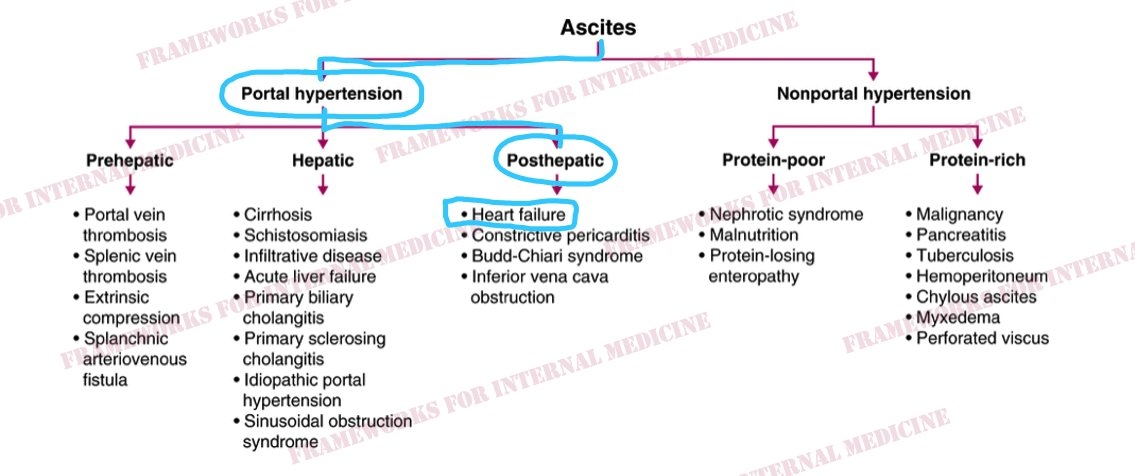
A “diagnostic” paracentesis wasn’t requested, but the underlying cause of ascites in this case has never been questioned. You consult your framework for ascites: The first question you want to know is whether the process is driven by portal hypertension or not.

Clue 4

Serum albumin is 3.1 g/dL and ascitic fluid album is 0.8 g/dL, yielding a serum-ascites albumin gradient (SAAG) of 2.3 (>1.1), which is consistent with a portal hypertensive process.

Clue 5

Next you wonder if the cause of portal HTN is prehepatic, hepatic, or posthepatic. For this you return to the cornerstone of diagnostic medicine, the history and physical examination. You recall the hypothesis generated by the dilated forehead veins and you evaluate the JVP.

The patient is upright in the video. What do you think right atrial pressure is? High? Low? Normal?

It is markedly elevated. Pointing you in the direction of posthepatic causes of portal hypertension.

Clue 6

An echocardiogram is performed, demonstrating severe systolic dysfunction.

Clue 7

You diagnose the patient with HF with reduced systolic function, likely caused by chemotherapeutic agents. While cirrhosis and malignancy are common causes of ascites, other etiologies should always be considered. Heart failure is the cause of ascites in this case.

End of case.

Teaching physical diagnosis through a library of real clinical findings.

  • About
  • Resources
  • Privacy
  • Acknowledgments