Physical Diagnosis PDX
Library
Cardiology Atlas Tutorial
Neurology Atlas Tutorial
Rheumatology Atlas Tutorial
Endocrinology Atlas Tutorial
Gastroenterology Atlas Tutorial
Pulmonology Atlas Tutorial
Infectious Disease Atlas Tutorial
Hematology-Oncology Atlas Tutorial
Nephrology Atlas Tutorial
Nails Atlas Tutorial
Hereditary Atlas Tutorial
Miscellaneous Atlas Tutorial
Cases Lectures Quizzes About
Library

Cardiology

Atlas Tutorial

Neurology

Atlas Tutorial

Rheumatology

Atlas Tutorial

Endocrinology

Atlas Tutorial

Gastroenterology

Atlas Tutorial

Pulmonology

Atlas Tutorial

Infectious Disease

Atlas Tutorial

Hematology-Oncology

Atlas Tutorial

Nephrology

Atlas Tutorial

Nails

Atlas Tutorial

Hereditary

Atlas Tutorial

Miscellaneous

Atlas Tutorial
Cases Lectures Quizzes About
  1. Home
  2. Cases
  3. Epiglottitis, Pancreatitis, AKI

lupus4.png

File is not under priv/media.
Case 38 Nephrology

Epiglottitis, Pancreatitis, AKI

Work it one clue at a time. The diagnosis stays hidden until you reveal it.

Clue 1

A young woman is admitted with acute epiglottitis (w H flu bacteremia). While hospitalized she develops acute pancreatitis and hematuria with AKI.  

A confusing constellation of problems. How can we glue this story together?

Clue 2

In a patient with hematuria, the first question I always ask is as follows: what is the source of that blood? Is it glomerular or non-glomerular?

Clue 3

How can we tell if the bleeding is glomerular or not? We have to evaluate the urine sediment. But the eyes can’t see what the mind doesn’t know. So what are we looking for?

Clue 4

Clue 5

What is the shape of the RBCs? Normal shape (isomorphic)? Or are they abnormal in shape (dysmorphic) because they have squeezed through an inflamed glomerulus? If we look closely some of these RBCs are indeed dysmorphic (purple arrows). Blue arrows point to isomorphic RBCs.

Clue 6

When those RBCs squeeze through the glomerulus they end up in the tubules, where they can form casts.

Check out what @OHSUnephrology found below. That’s an RBC cast ! Another clue that our bleeding source is glomerular.

Clue 7

Our patient has hematuria of glomerular origin.

Clue 8

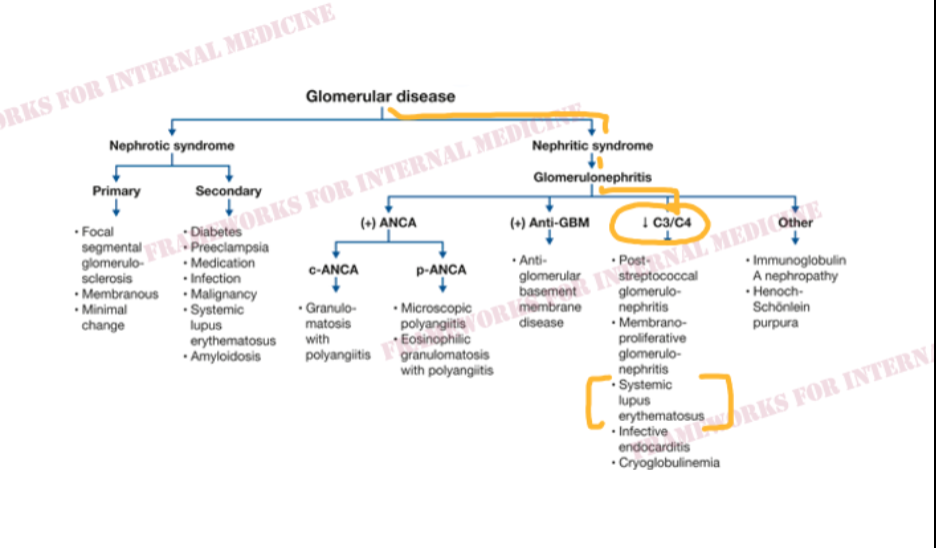
I like to approach GN serologically.

Clue 9

But instead of just ordering all of those labs simultaneously at a high cost, history and physical exam should guide that workup. Let’s revisit the exam. What is this skin lesion?

Clue 10

Retrospective history is obtained and reveals at least one year of joint pain/stiffness mostly in the mornings. 

Workup for SLE revealed + ANA (titer 1:2560, homogenous), very low C3/C4 levels, and a renal biopsy with class IV lupus nephritis.

Clue 11

This patient likely had an underlying SLE for some time. The acute epiglottitis triggered a flare, manifesting with malar rash, GN, and acute pancreatitis. This allowed for the diagnosis to be made.

For more details of this case, check out: https://casereports.bmj.com/content/18/6/e264956

End of case.

Teaching physical diagnosis through a library of real clinical findings.

  • About
  • Resources
  • Privacy
  • Acknowledgments