Physical Diagnosis PDX
Library
Cardiology Atlas Tutorial
Neurology Atlas Tutorial
Rheumatology Atlas Tutorial
Endocrinology Atlas Tutorial
Gastroenterology Atlas Tutorial
Pulmonology Atlas Tutorial
Infectious Disease Atlas Tutorial
Hematology-Oncology Atlas Tutorial
Nephrology Atlas Tutorial
Nails Atlas Tutorial
Hereditary Atlas Tutorial
Miscellaneous Atlas Tutorial
Cases Lectures Quizzes About
Library

Cardiology

Atlas Tutorial

Neurology

Atlas Tutorial

Rheumatology

Atlas Tutorial

Endocrinology

Atlas Tutorial

Gastroenterology

Atlas Tutorial

Pulmonology

Atlas Tutorial

Infectious Disease

Atlas Tutorial

Hematology-Oncology

Atlas Tutorial

Nephrology

Atlas Tutorial

Nails

Atlas Tutorial

Hereditary

Atlas Tutorial

Miscellaneous

Atlas Tutorial
Cases Lectures Quizzes About
  1. Home
  2. Cases
  3. Hyponatremia

hyponatremia9.png

File is not under priv/media.
Case 32 Endocrinology

Hyponatremia

Work it one clue at a time. The diagnosis stays hidden until you reveal it.

Clue 1

A 60 y/o woman presents with subacute, progressive, severe hyponatremia (Na 118).  

Let’s walk through an approach to this common problem.

Clue 2

First we confirm we are dealing with hypotonic hyponatremia.

Clue 3

This begins to narrow our differential.  

Next we want to know the status of extracellular fluid volume. Our patient has low JVP, no peripheral edema, and dry mucous membranes, narrowing our differential even further.

Clue 4

Is the hypovolemia renal or extrarenal? Urine sodium can be helpful here. Usually in the setting of hypovolemia, urine Na should be very low (usually <10) as the kidneys try to hold on to salt/water to preserve volume.

Clue 5

In our case, urine sodium is unexpectedly high. 

There are a few conditions in which hypovolemic hyponatremia is associated with an unexpectedly high urine Na, because the urine IS the source of the Na/fluid loss.

Clue 6

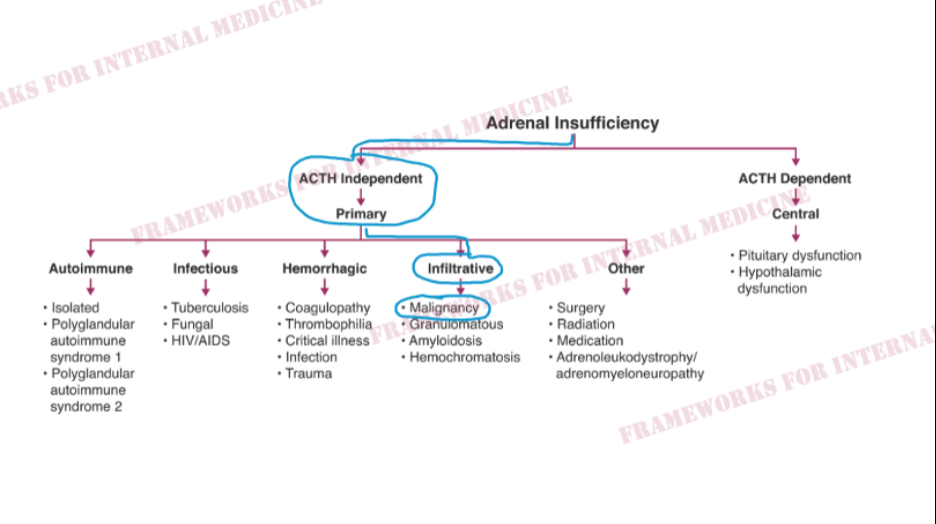
Our patient is not on diuretics. But she does have an adrenalectomy for RCC, leaving her with a solitary adrenal gland. An ACTH stim test is in order.

Clue 7

It is positive (meaning that cortisol did not appropriately rise above 18).

Clue 8

Plasma ACTH levels drawn prior to the stim test are elevated, indicating that we are dealing with primary (ACTH-independent) adrenal insufficiency.

Clue 9

The solitary right adrenal has several tumors in it (metastatic from previously known RCC). The cause of our patient’s hyponatremia is adrenal insufficiency secondary to infiltration with malignancy.

End of case.

Teaching physical diagnosis through a library of real clinical findings.

  • About
  • Resources
  • Privacy
  • Acknowledgments