Physical Diagnosis PDX
Library
Cardiology Atlas Tutorial
Neurology Atlas Tutorial
Rheumatology Atlas Tutorial
Endocrinology Atlas Tutorial
Gastroenterology Atlas Tutorial
Pulmonology Atlas Tutorial
Infectious Disease Atlas Tutorial
Hematology-Oncology Atlas Tutorial
Nephrology Atlas Tutorial
Nails Atlas Tutorial
Hereditary Atlas Tutorial
Miscellaneous Atlas Tutorial
Cases Lectures Quizzes About
Library

Cardiology

Atlas Tutorial

Neurology

Atlas Tutorial

Rheumatology

Atlas Tutorial

Endocrinology

Atlas Tutorial

Gastroenterology

Atlas Tutorial

Pulmonology

Atlas Tutorial

Infectious Disease

Atlas Tutorial

Hematology-Oncology

Atlas Tutorial

Nephrology

Atlas Tutorial

Nails

Atlas Tutorial

Hereditary

Atlas Tutorial

Miscellaneous

Atlas Tutorial
Cases Lectures Quizzes About
  1. Home
  2. Cases
  3. Tea-Colored Urine

pnh14.png

File is not under priv/media.
Case 37 Nephrology

Tea-Colored Urine

Work it one clue at a time. The diagnosis stays hidden until you reveal it.

Clue 1

A 30 year old man presents with tea-colored urine.

Clue 2

Our instinct is to consult the framework for hematuria:

Clue 3

Then we realize that while the color of the urine could absolutely be consistent with hematuria, there are mimics of hematuria that should be considered as well.

Clue 4

How can we confirm if A) hematuria, or B) a mimic? 

Urine microscopy. And in this case, there are 0 RBCs in the urine. Indicating the dark colored urine is a hematuria mimic. 

Let’s take a step back from the books and computers and meet our patient. What do you notice?

Clue 5

Any time I am confronted by a jaundiced patient, the very next question on my mind is whether the hyperbilirubinemia is direct (conjugated) or indirect (unconjugated).

In this case, it’s mostly indirect.

Clue 6

But how can the urine be dark in the setting of unconjugated hyperbilirubin, which is insoluble and doesn’t appear in urine? 

Intravascular hemolysis.

Clue 7

Indeed, hemolysis labs are wildly positive in this case. 

Except for the reticulocyte count, which you would expect to be elevated in the setting of hemolysis. More on that in a bit.

Clue 8

Let’s take a step back and consult our framework for hemolytic anemia. 

The age of our patient suggests that an inherited cause of hemolytic anemia is unlikely. So we focus on the acquired causes.

Clue 9

There is no history to suggest toxic ingestion or infection. And no schistocytes on the peripheral smear to suggest a microangiopathic hemolytic anemia. So we focus on immunologic causes of hemolysis.

Clue 10

Most immunologic causes of hemolysis result in extravascular hemolysis, where the RBCs are tagged by the immune system for destruction in the reticuloendothelial system. 

Our patient’s dark urine tells us that he has intravascular hemolysis. 

Do any of the entities underneath the immunologic arm of the framework result in intravascular hemolysis?

Clue 11

There is another clue to the diagnosis in this case. Our patient has pancytopenia.

Clue 12

The bone marrow isn’t working properly. But we already knew that because the reticulocyte count (3.6%) was way lower than expected in a case of hemolytic anemia. 

Is there an overlapping entity between the hemolytic anemia framework and the pancytopenia framework?

Clue 13

You bet there is.

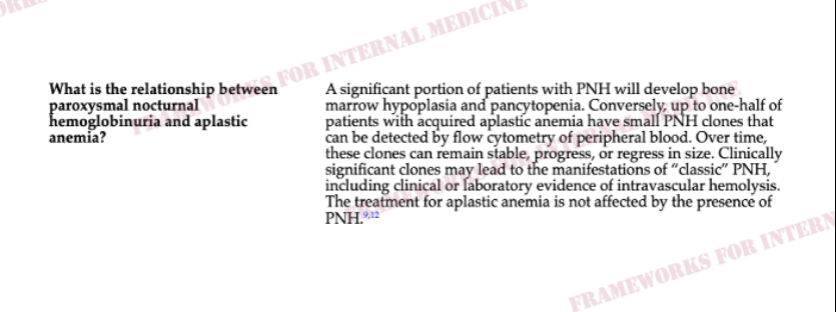
What is PNH?

Clue 14

Clue 15

Frameworks are a great way to approach cases. When there are disparate problems in the same patient, consulting multiple frameworks and seeing where there is overlap (like a Venn diagram) is extremely helpful.

End of case.

Related findings

Important Books

Teaching physical diagnosis through a library of real clinical findings.

  • About
  • Resources
  • Privacy
  • Acknowledgments